An everlighter anchor 2
12.10.2024-09.11.2024
PICCA: CONTEMPORARY ART GALLERY
Via Diaz 18,
61121 Pesaro (PU)
Edited by Giuseppe Tomasello, Elisa Di Domenicantonio

Kiril Cholakov
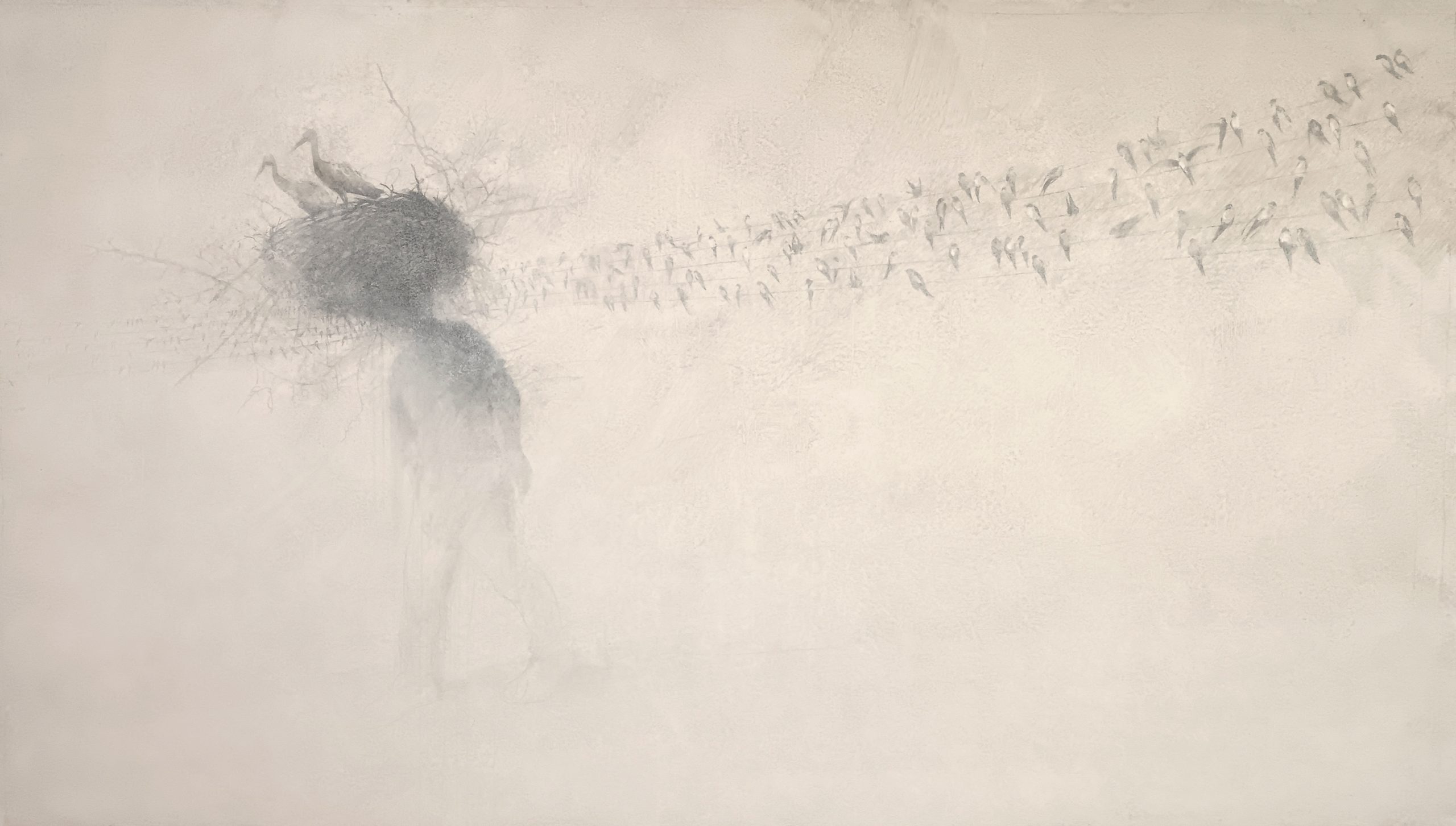
An ever lighter anchor”, 2026
Acrylic, pencil and ash on canvas
150 x 260 cm
A single large canvas – measuring 160 centimeters by 2.60 meters – will act
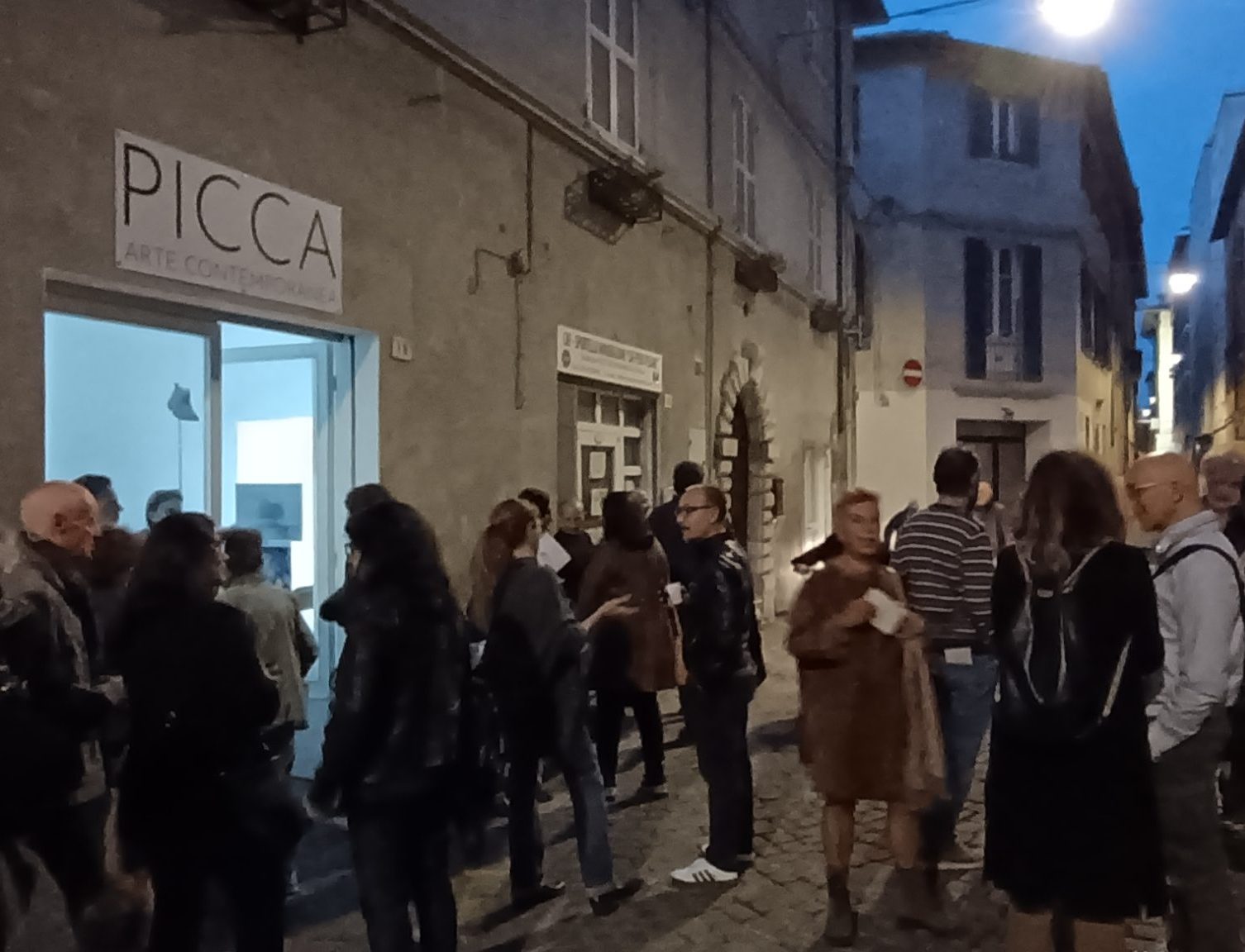
as a magnet to the curious gaze of those who, on Saturday, from 6 p.m., will
gather at Picca Arte contemporanea. Until Nov. 9, visitors will be able to meet
the poetics of Kiril Cholakov, a multifaceted artist of Bulgarian origin who is
the absolute protagonist of the solo exhibition with the dreamy title “An ever
lighter anchor”. The art gallery at 18 Diaz Street in Pesaro, founded by
Giuseppe Tomasello and Elisa Di Domenicantonio, invites the public to the
vernissage of the exhibition and reminds visitors that access is by reservation
only. Visitors can secure their spot in the following days, by writing to
piccartecontemporanea@gmail.com
Kiril’s works – as the curators note – “are often concerned with social and
political issues, through studying the themes of inner “disorientation”,
loneliness, collective and personal memory, the relationship between man
and nature – expressed in different languages and techniques. Drawing,
painting, sculpture, photography, installation, and video are interchangeable
for Kiril, the visual poet.”
PICCA Contemporary Art Gallery



FRA/(BETWEEN)
Solo exhibition by Kiril Cholakov, with excerpts from book-phantoms by Irina Batkova
THE NATIONAL GALLERY SOFIA ARSENAL – MUSEUM OF CONTEMPORARY ART
15.12.2022–29.01.2023
Curator: Nadezhda Dzhakova


Kiril Cholakov has given his exhibition at the museum the title of FRA/BETWEEN. Not only because the artist lives and works, travelling between two places – Rimini, Italy and the village of Izvor in Bulgaria, between two different languages and cultures; but also because he places the viewer in the position of being FRA/BETWEEN the artist’s personal history, private recollections, the whims of consciousness and the reality we are involved in, our collective memory and common biography; between the anecdotes that sneak into his journal of drawings, to universal truths.
Kiril Cholakov’s solo exhibition includes two characters: first, that of the artist and the other – a character from the book-phantom. Led by their curator, the pair embark on a strange game even before having met.
Nadezhda Dzhakova has invited the writer Irina Batkova to compose a text that responds in an unusual way to the artist’s oeuvre, to appear in the exhibition as excerpts from book-phantoms. In addition to Kiril Cholakov’s drawings, site-specific works, and paintings, and the extracts from book-phantoms by Irina Batkova, a video portrait of the artist by director Milena Kaneva can also be viewed.
In literary passages, Kiril Cholakov discovers visual images for his drawings.
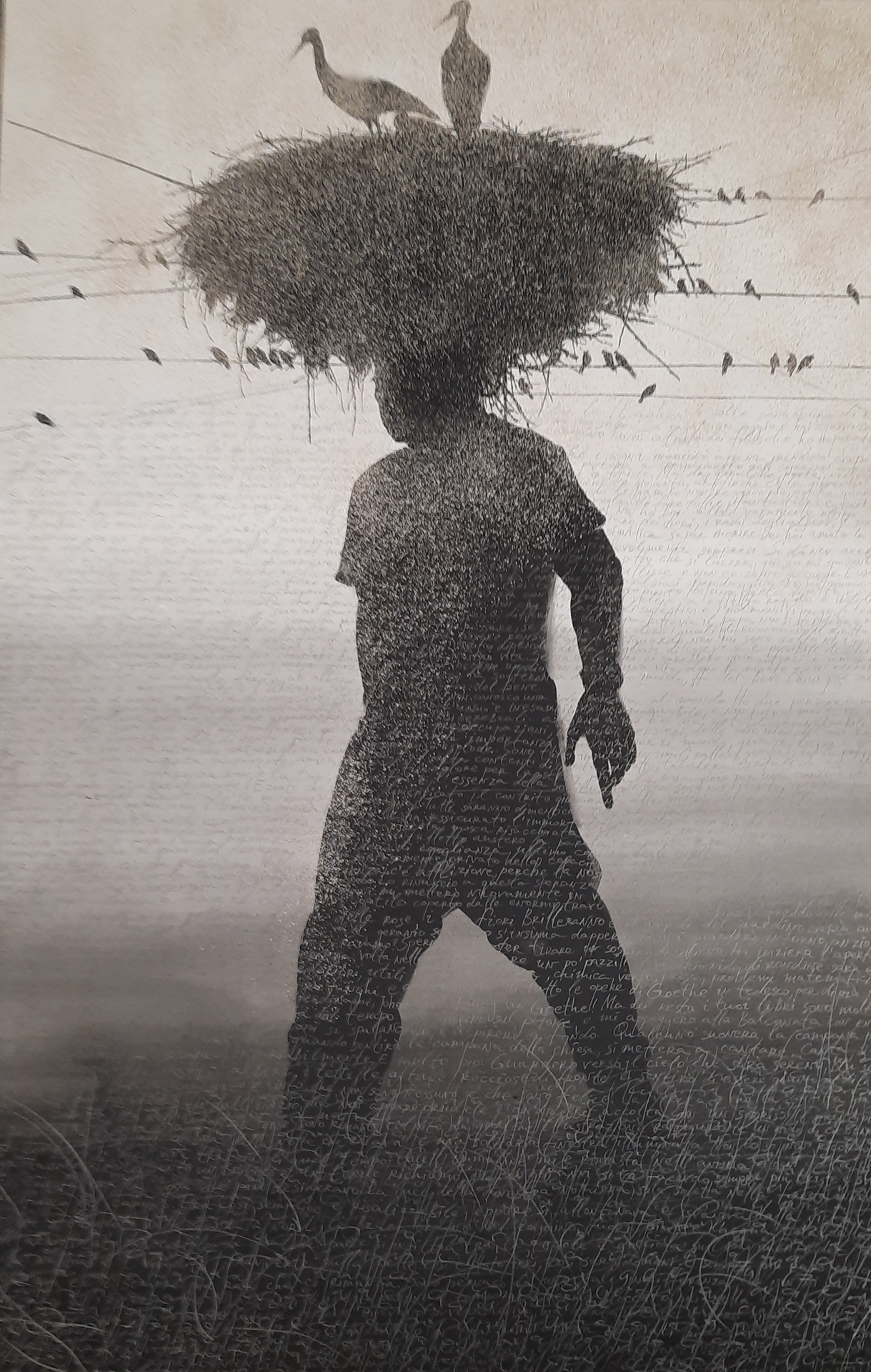
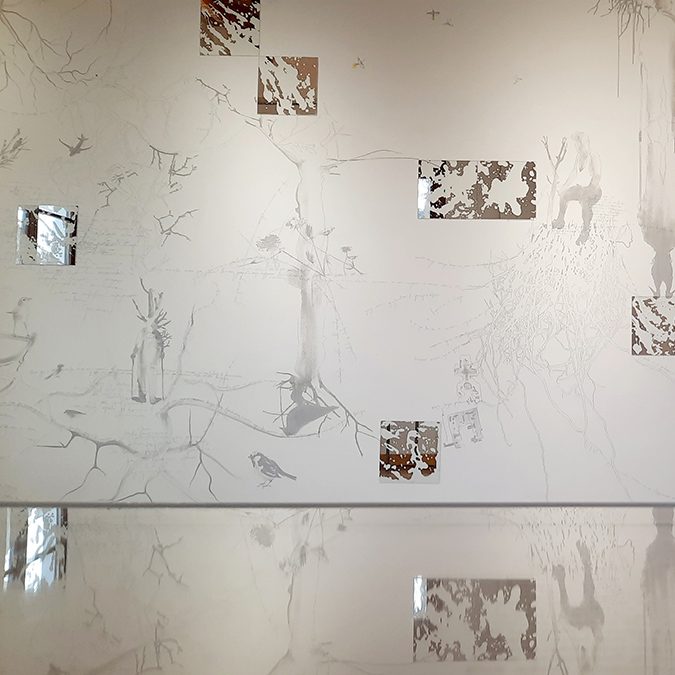
Thus, the hero of the book suddenly sneaks into the large-format entanglement of drawings that the artist creates on the museum walls. The image of the man-stork, having woven a nest of his thoughts and ideas, walking through the fog and snow, turning into a lonely bare tree, follows his creator, the artist, from one gallery to the next. The author-artists in the exhibition become more than one, while the tale transforms into multiple narratives that often have no beginning or end.
The character from the book-phantom speaks of such places of new possibilities, in which the chain of events where one thing turns into something else – is perceptible. The seemingly chaotic directions resemble a labyrinth, which after a long, winding trail leads you back to the beginning…
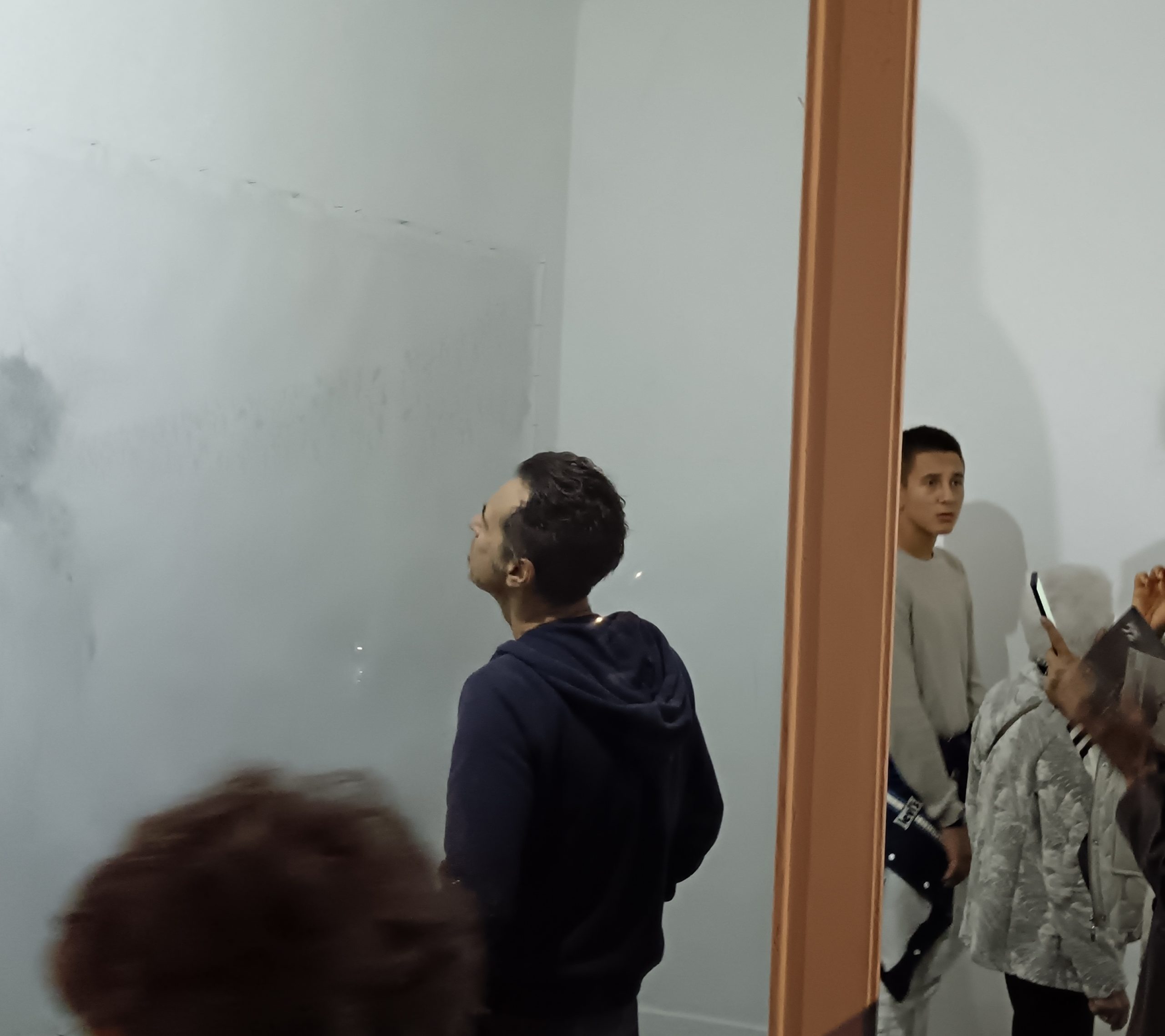
Such is the large-format drawing on the wall: a place for observation that, with prolonged staring, loses its clear outlines – the silhouettes of objects, animals, plants, and people become emptied of narrative, disintegrating to form ‘a new web’, an all-consuming or, rather, an all-embracing vision. FRA/BETWEEN is a special space for shifting layers, for breaking down and rebuilding images. A transitional space generated by the encounters or the brushing together of different worlds, a border point of disintegration, a farewell to observing the images of the material world and the building of new ones.
The drawing on the walls of the museum will gradually fade out and, when the exhibition ends, it will disappear, just as our memories are obliterated with time.
The exhibition is the sixth in the Autobiography Project of the Sofia Arsenal – Museum of Contemporary Art programme.
Curator: Nadezhda Dzhakova


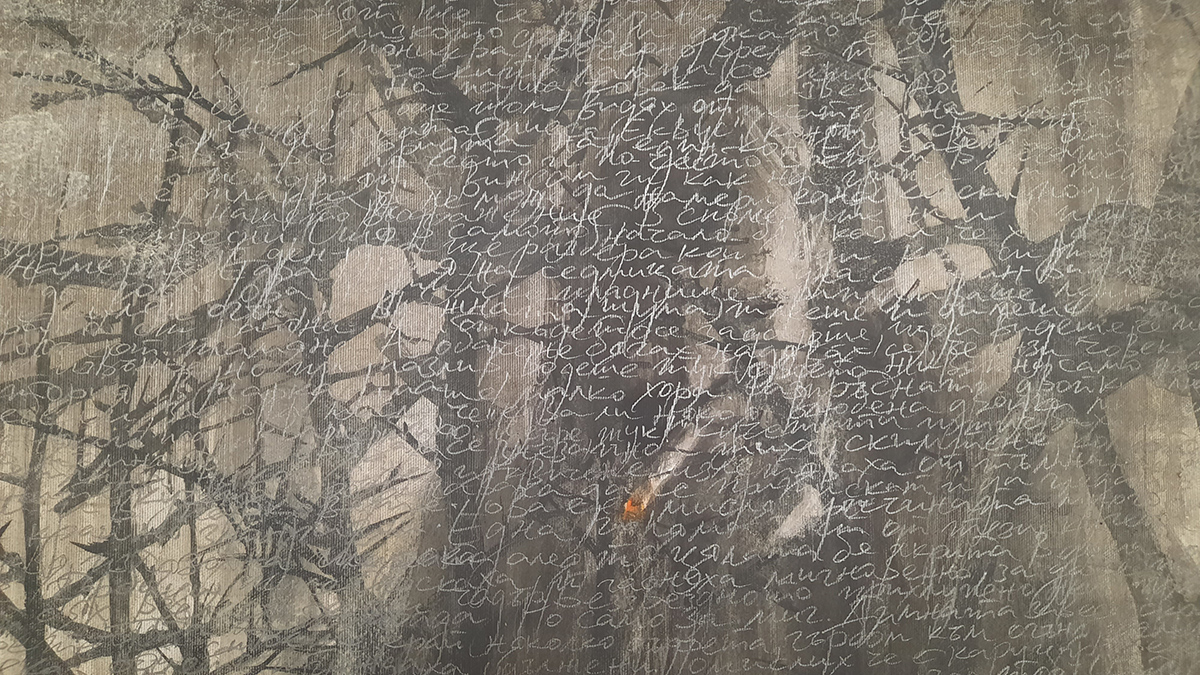
In 2021, Dr. Nadezhda Dzhakova presented me with an unexpected challenge when she invited me to participate as an author in an exhibition alongside the artist Kiril Cholakov. I have known Kiril’s work for many years and have curated two of his exhibitions, but the idea of being a co-author in a shared project shifted my perspective from an external analyst of his artistic world to literally becoming a part of it. What made it easier for me to choose the media for my contribution to the exhibition was my long-term observation of his work, which has always been connected to text-whether literary or academically analytical. Since the artist lives between two countries and uses both text and images in his visual practice, we decided that the name of the exhibition should be “Between.” This became the starting point for my work on the project as well-participating in the creation of a special space between words and images, one that immerses the viewer not only in perceiving the objects of the exhibition but also in analyzing their own perceptions.
My exhibition objects are manuscripts of non-existent phantom books. They tell the stories of a person who gradually loses his sight and begins to create a library of mental images, which will serve him when he can no longer see, and of a female artist who analyzes the colors of the surrounding world and attempts to create working models from her observations in order to teach her students. The texts gradually intertwined with the important themes that Cholakov has been working on for years—how memories are formed, what the nature of the feeling of nostalgia is, how we sense the passing of time and the traces it leaves in our lives, and what the role of our personal stories is in the collective memory, among others. Thus, the territory between the texts and the images gradually created an unusual vortex, into which the visitors of the exhibition were drawn, and it became a space for new conversations, new
memories, and a new rethinking of our work on this project. The manuscripts from the phantom books continue to appear…
Irina Batkova


FALSO MOVIMENTO
30 .10.2024-05.12.2024
Zamagni Contemporary Art Gallery, Rimini.
Kiril Cholakov | Denis Riva
Curator:Valerio Dehò
“A House Beyond the World” – at the beginning of this series, which I’ve continued to work on for over 20 years, is a true story that evokes images I feel strongly about:
Some time ago one stork failed to fly away with the others (Izvor is a small Bulgarian village, located on one of the migration routes of storks – birds that arrive there “from time to time” in spring and leave every time at the end of summer). When the mists returned in November, the stork’s lonely silhouette could be seen emerging in the nest on the electricity pole. In time, a stranger from the village, nicknamed “Bohemeau,” began to bring him something to eat, and so gradually the Stork, no longer afraid of him, came down from the nest and began to accompany him all the way to his house, and when the big snow came, Bohemeau took him inside to his warm home. This gesture provoked the ironic comments of the neighbours because the animal is an animal and by presumption should not enter the house because it is dirty and should know its place outside in the yard. Boheme, however, did not care about the comments and he told everyone that “he and Shcherko had made friends and that he was a very good animal” ( at this end they use the word “good” to express many things, it seems to them somehow more urban and twisted )…. And the stork followed him everywhere in his footsteps, so the two went down at dusk to the “centero” for cigarettes and half a loaf of bread,and to stop for a chat in the pub and to “hit” a rakia; but there the villagers wouldn’t let the stork in, and he stood outside the door to the left and waited for hours, motionless. . and then the two of them slowly, step by step, walked up into the darkness under the falling snow…
When spring came and the other storks came back to the village, “our” one flew to meet them and they killed him with their beaks…
Kiril Cholakov